An Active Electrical License
Check the contractor's current Arizona ROC license and confirm its electrical classification covers your property type. Ask for verifiable liability insurance before approving the work.
Phoenix Electrical Panel Upgrades explains how to choose a licensed electrical contractor for a panel upgrade in Phoenix, Arizona. The right contractor checks your electrical load, identifies any meter or service work, and plans the permit and inspection process before the power goes off.
Check the contractor's current Arizona ROC license and confirm its electrical classification covers your property type. Ask for verifiable liability insurance before approving the work.
A contractor replacing an older residential panel needs different project experience from one upgrading a large commercial service. Describe the existing amperage, meter location, and loads you plan to add.
Ask for a load calculation and a clear scope covering the panel, meter equipment, grounding, and any circuit updates. A fixed quote should follow the property assessment.
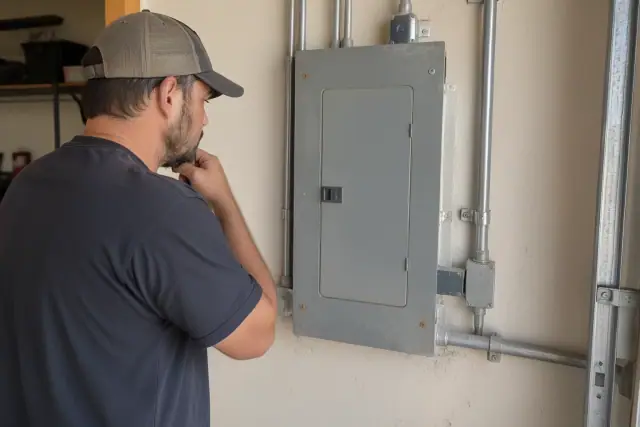
A panel in a 1960s or 1970s Maryvale home needs an assessment of its condition and available capacity. The electrician should account for existing air conditioning and planned additions.
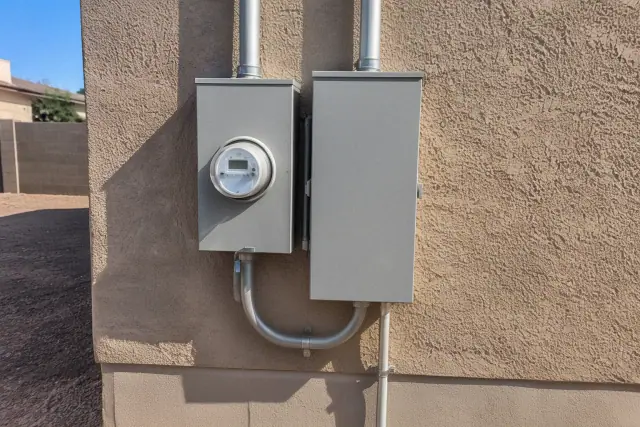
The meter socket and service mast help determine whether the project extends beyond the panel itself. Meter work also affects utility coordination and the outage schedule.
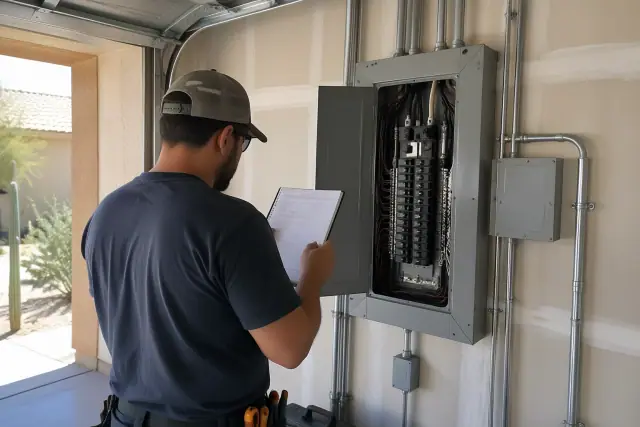
A load calculation accounts for appliances, HVAC, and planned EV charging. It helps the contractor explain the recommended service size before you approve an upgrade.
Confirm which licensed electrical contractor is responsible for the installation, permit, and inspection. Ask how utility coordination will be handled if the meter equipment needs replacement.
A panel swap, a full service upgrade, and a subpanel installation have different scopes. Compare meter socket, mast, grounding, wire run, and trenching needs before comparing quotes.
Repeated breaker trips, flickering lights when the AC starts, warmth, or discoloration call for an electrician's evaluation. Burning smells or visible scorching need immediate attention; do not open the panel to investigate.
Do not accept an offer to skip required permits or choose amperage without a load calculation. Ask the local building department about any owner-builder eligibility; a possible exemption does not remove permit or code requirements.
| Project | Who to hire | What to confirm before work |
|---|---|---|
| Replace a 100- or 150-amp panel with 200-amp service | Licensed electrical contractor experienced in residential service upgrades. | Load calculation, existing wiring condition, and whether meter equipment also needs replacement. |
| Replace the meter socket or service mast | Licensed electrical contractor experienced in meter and service equipment work. | Utility disconnect and reconnect arrangements, grounding and bonding scope, and inspection schedule. |
| Install 400-amp service | Licensed electrical contractor with experience in larger residential or commercial services, as appropriate. | Calculated demand, a single panel or two 200-amp panels, and any commercial three-phase requirements. |
| Add a garage, workshop, or casita subpanel | Licensed electrical contractor experienced in subpanel and detached-structure wiring. | Main service capacity, feeder amperage, wire run length, and any trenching needs. |
| Investigate repeated trips or panel damage | Licensed electrical contractor who can diagnose breaker faults and thermal damage. | Whether the fault needs an individual breaker replacement or wider panel replacement; do not assume a larger service fixes it. |
For every scope, verify the appropriate license, required permit, and inspection responsibilities before approving the work.
Choosing who upgrades your panel means checking both licensing and experience with the work involved. The contractor should evaluate existing wiring, calculate the load, identify grounding and bonding work, and explain permit and inspection responsibilities. An older bungalow in Sunnyslope or Coronado may need a different scope from a larger Biltmore-area home; a historic property in Willo or F.Q. Story may also need additional permitting steps. Panel age helps frame the assessment: equipment over 25 years old deserves closer evaluation, and a fuse box or panel over 40 years old should be discussed even if it still supplies power. For a panel installed before 1980, ask specifically about its condition and capacity rather than assuming an absence of symptoms means it is suitable.
Typical Phoenix-area 200-amp upgrades run $1,240 to $2,066, with panel location and meter placement affecting the price. Full service upgrades involving meter and mast work may reach $3,000 to $5,000; complex projects involving meter socket, mast, and grounding work can run $5,000 to $30,000. A 400-amp upgrade typically costs $5,000 to $15,000, depending on a single-panel or paired 200-amp configuration. Subpanel installation typically runs $800 to $2,500, depending on amperage, wire run length, and trenching; an individual breaker replacement generally runs $150 to $400, depending on breaker type and compatibility. These are different jobs, so compare what each quote includes. An on-site assessment establishes whether you need a capacity increase, distribution to a detached structure, or repair of a specific fault.
Can I upgrade the panel myself? Arizona has conditional owner-builder exemptions, but eligibility and the permitted scope need confirmation with the local building department; main service work is best handled by a qualified electrical contractor. Can I go from 100 to 200 amps? Yes, this is a common upgrade, although the meter equipment and grounding may also need changes. Will the whole house need rewiring? Usually not, but older ungrounded two-wire circuits may need attention for particular uses. How should I prepare? Clear access to the panel and meter, keep pets and vehicles out of the work area, and plan for several hours without electricity, especially if medical equipment or refrigerated goods need continuous power.
Share the property's panel age, any recurring symptoms, and planned loads such as EV charging or an added AC unit. An on-site assessment often takes about 30 minutes to help determine whether repair or replacement makes sense; the load calculation and existing equipment guide the fixed quote.